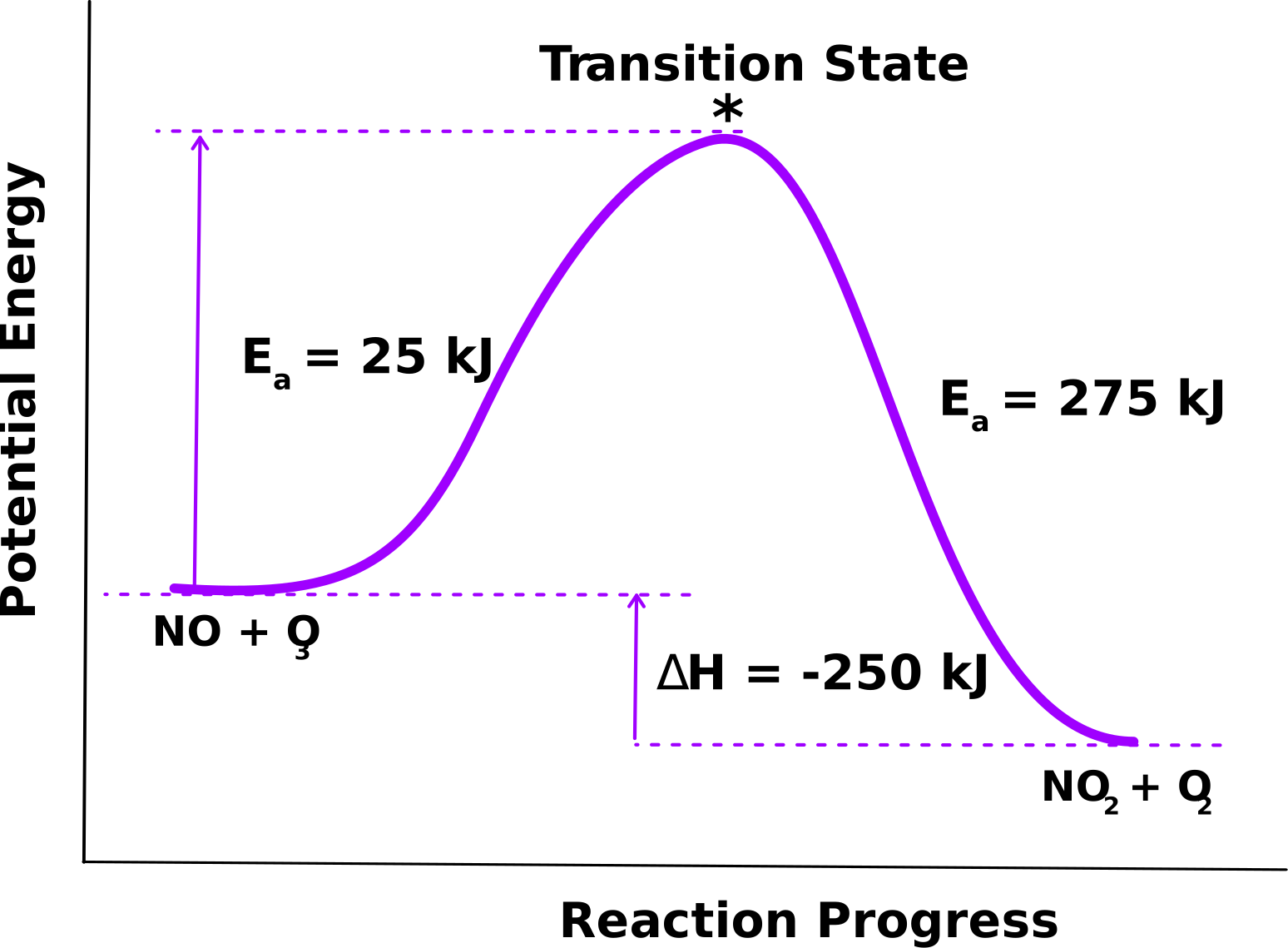
Recall, equilibrium is dynamic and is the result of the forward and reverse reaction rates being equal to one another. In a previous study guide, we related the rate constants for a one step reaction to the equilibrium constant.
For the general reaction:
We assume both the forward and reverse reactions will occur in one single step making them elementary reactions. The rates of the forward and reverse reaction are written as:
\(\displaystyle rate_f=k_f[A]^a[B]^b\) \(\displaystyle rate_r=k_r[C]^c[D]^d\)
At equilibrium, the rates of the forward and reverse reaction are equal. Below, we set the rates equal.
\(\displaystyle k_f[A]^a[B]^b=k_r[C]^c[D]^d\)
Rearranging the equation:
\(\displaystyle \frac{k_f}{k_r}=\frac{[C]^c[D]^d}{[A]^a[B]^b}\)
We see that \(\displaystyle \frac{k_f}{k_r}\) is equal to the equilibrium constant, Kc. Now we can write,
\(\displaystyle \frac{k_f}{k_r}=K_c\)
Recall, the value of K is only dependent on the temperature and not on the concentration, pressure or volume. For an exothermic reaction a temperature increase will decrease the value of the equilibrium constant, K. If the temperature is decreased, the value of the equilibrium constant will increase. For an endothermic reaction, an increase in temperature will increase the value of the equilibrium constant, while a decrease in temperature will decrease the value of the equilibrium constant.
Consider the Arrhenius equation below.
\(\displaystyle k=Ae^{-E_a/RT}\)
From the equation, we can see if the temperature increases, the rate constant also increases. Because the forward and reverse reactions have different activation energies, if the temperature is increased kf and kr will increase by different amounts. For an exothermic reaction, kf is greater than kr. If the temperature is increased, the value of kr will increase more than kf. The exponential term in the Arrhenius equation indicates a change in temperature will significantly impact the reaction with the higher activation energy.